

A dedicated designer
One expert owns your journey from first sketch to final boarding pass.
Last updated:
Quick answer: Mount Huangshan (Yellow Mountain) is a UNESCO World Heritage landscape of granite peaks, old pines, cloud formations and steep stone paths in Anhui Province. Huangshan’s municipal government lists 72 named peaks across a 160.6-square-kilometre scenic area; Lotus Peak reaches 1,864 metres. Plan two or three days if you want a full mountain visit with room for weather, entry reservations and transport between the gateways and trailheads.
Plan a private Huangshan trip: Request a tailored Huangshan itinerary. Include your dates, preferred entrance, hiking ability, cableway preference, luggage plan and onward destination. Ask the planner to confirm the route, tickets, shuttle or cableway arrangements, guide service, accommodation and what the quote includes.
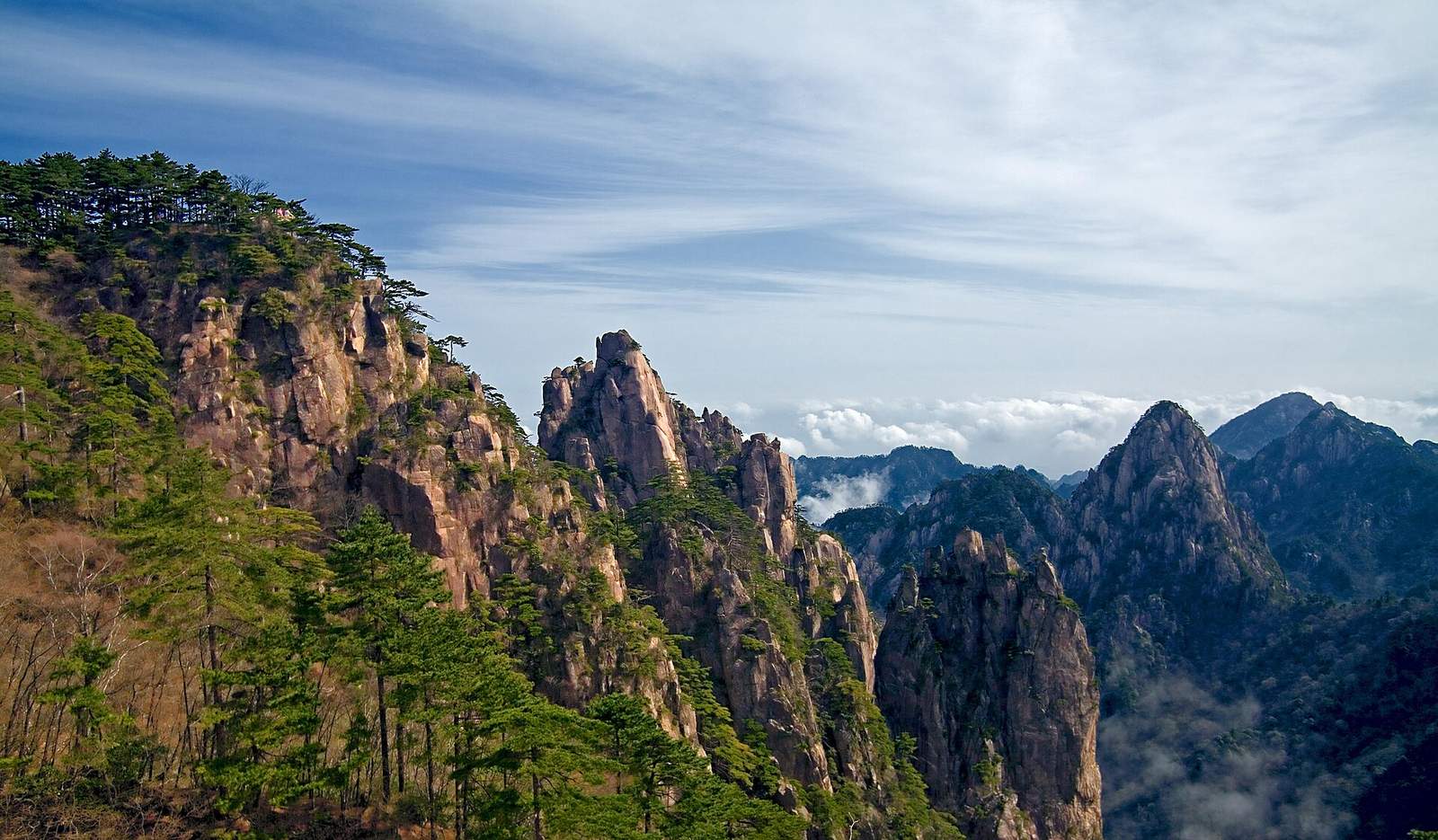
Huangshan is known for steep granite formations, ancient pines, cloud and mist effects, hot springs and winter snow. UNESCO recognizes both natural and cultural values: the mountain landscape has influenced Chinese painting and literature for centuries. The UNESCO listing applies to Mount Huangshan as a protected property; it does not mean every nearby village or scenic stop around Huangshan City shares the same status.
The main scenic area is large, steep and weather-exposed. A short stop at a low-elevation viewpoint is different from a summit walk. Huangshan’s official visitor information identifies Lotus Peak as the highest of 72 named peaks and notes a scenic-area boundary of 160.6 square kilometres. Those figures describe the destination, not a single walking route. Routes, trail access, gates, cableways and peak openings can change for maintenance, conservation or safety.
| Area or experience | Best fit | Check before you go |
|---|---|---|
| Summit-area trails and viewpoints | Visitors seeking the signature granite and pine landscapes | Which trailheads and peaks are open, route direction, steep steps, weather and your return time |
| Yungu or Yuping cableway access | Reducing part of the ascent or planning a shorter mountain day | Operating notice, reservation, queues, last service and any separate park shuttle |
| East Gate and East Sea area | Travellers comparing newer access options and eastern scenery | Confirm the current entrance, cableway schedule and how the route connects to your planned hike |
| Hot Springs area | Adding a lower-elevation recovery stop before or after the mountain | Venue hours, separate admission, transport and availability for your dates |
| Tunxi or a Huizhou village extension | Adding regional food, historic streets or village architecture | These are separate locations from the summit; confirm transfer time and overnight base |
One day can work for a focused mountain visit when you arrive near the correct gateway, have a confirmed entry slot and choose a route within your fitness and daylight limits. Two days provide more flexibility for a longer walk or overnight stay in the mountain area. Three days can combine the mountain with a lower-elevation stop such as Tunxi or a Huizhou village, subject to road time and opening arrangements.
| Time available | Sample structure | Planning use |
|---|---|---|
| 1 day | One gate, a preselected cableway or hiking approach, and a limited set of viewpoints | Short visit; build a firm turnaround time and do not add a distant village stop |
| 2 days | Arrival and access setup, then a full mountain day; or an overnight mountain stay with a second trail section | Most first-time hikers seeking more than a cableway-and-viewpoint visit |
| 3 days | Mountain visit plus one regional town or village, keeping transfers separate from the summit day | Travelers connecting Huangshan with wider Anhui or Shanghai itineraries |
Choose the route by the open gate, trail status, elevation changes, stair tolerance and return plan rather than by a list of famous peaks. A cableway shortens part of an approach but does not remove the steep steps and walking between viewpoints. Ask for the route’s starting point, distance, ascent and descent, expected time, cableway use, rest points and exit option. A route description that only says “Huangshan hike” is not enough to judge its difficulty.
Lotus Peak and Mount Tiandu are managed with conservation and safety closures. The official English portal reported Mount Tiandu reopened on 7 April 2026 after winter maintenance and that online reservation was required; this is a dated notice, not a guarantee of present access. Check the official Huangshan booking platform close to travel for peak availability, trail closures, ticket identity rules and the entrance assigned to your reservation.
In June 2026, Huangshan opened its East Gate and began East Sea cableway operations, creating another access option alongside established gates. This changes the way a route can be planned, but does not make the gateways interchangeable: the right choice depends on your hotel, trail plan, reservation and onward transfer. Verify the entrance printed on the ticket and the shuttle or cableway connection before departure.
Allow a buffer for transfers between Huangshan North railway station, Tangkou, the mountain gates and any hotel. Train-to-gate travel time depends on the exact station, road, weather and transport mode. If you stay on the mountain, confirm your lodging’s location, baggage arrangements and the time you must reach it. Do not assume that a hotel near “Huangshan” is close to the scenic gate.
Huangshan is promoted as a year-round destination, but the experience changes with cloud, rain, heat, cold and snow. Spring and autumn often suit long walks; summer can bring rain and humid conditions; winter can mean ice and temporary closures. No season guarantees a sea of clouds or a clear sunrise. Check the weather forecast and official opening notices shortly before travel and keep a flexible route if wind, lightning, snow or poor visibility affects exposed paths.
Huangshan’s municipal government lists Lotus Peak as the highest summit at 1,864 metres. Other peaks and viewpoints have different elevations, so this is not the height of every hiking route.
Allow at least one full day for a focused mountain visit; two days provide more flexibility for a longer hike or overnight stay. Add a third day for a separate town or village.
Access can change with conservation rotations, maintenance and weather. Confirm current openings and reservation requirements on the official platform before fixing your route.
No. Cableways reduce part of the ascent but visitors still walk steep, stepped paths between viewpoints. Choose a route by your mobility, fitness and return time.
Sources checked 3 November 2026: Huangshan Municipal Government, Mount Huangshan profile (72 peaks, 160.6-square-kilometre scenic area and Lotus Peak at 1,864 metres); UNESCO World Heritage Centre, Mount Huangshan; Huangshan Municipal Government, Mount Tiandu reopening and reservation notice, 7 April 2026; Huangshan Municipal Government, East Gate and East Sea cableway opening, June 2026. Photo by Chi King on Wikimedia Commons, licensed under CC BY 2.0.
Editorial method: This desk-researched guide uses UNESCO and municipal scenic-area notices and does not claim a first-hand visit. We distinguish the broad scenic area from an individual hiking route, avoid promising current opening status, and direct visitors to the official booking notice for changeable schedules, access and weather closures.
“A private tailor-made journey in Mount Huangshan allows you to explore at your own unhurried pace, with private transfers and local guides revealing cultural layers that standard tours overlook.”
— Emily, China Destination Specialist at My Way Travel
Explore key landmarks and points of interest across Mount Huangshan
Call our direct travel designer desk or request your complimentary bespoke proposal.


The World On Your Terms reveals what awaits when you explore the globe with our specialists. Covering six continents, this volume features handpicked routes, insider tips, and signature experiences.
Request Your Copy
Why journey with us
One expert owns your journey from first sketch to final boarding pass.
Closed doors open quietly: ateliers, cellars, private homes, museums after dark.
A real voice at 3 a.m. in any time zone, whatever the question.
Bonded, insured and transparent about every dollar before you commit.
Begin
Tell us how you dream of travelling. Within 24 business hours, an in-country specialist will curate the first sketch of your route — bespoke ideas first, commitment never.
Concierge available 24/7 across all Asian time zones · New York registered